South Africa’s economic landscape is driving significant and unprecedented shifts in national tax policy. Faced with the dual challenge of accelerating economic recovery and addressing fiscal constraints, the government is adopting a dual-track approach. Recent years have seen not only rapid legislative changes but also the integration of cutting-edge, technology-driven enforcement mechanisms aimed at improving tax compliance. With economic forecasts predicting a modest GDP growth of 1.6% in 2026 and a gradual narrowing of the budget deficit, these policy adjustments are seen as a crucial strategy to boost revenue without derailing the fragile economic recovery.
For individual taxpayers and corporate entities alike, these developments are far-reaching. Heightened enforcement and emerging compliance requirements mean that tax professionals, businesses, and households must remain vigilant and adapt quickly to these shifting requirements. The increasing emphasis on modern technology, such as data-driven audits and enhanced efficiency in revenue collection, underscores the need for proactive planning and meticulous adherence to tax regulations.
This evolving framework signals a new era in South African taxation, where preparedness will be vital to navigating its complexities.

The Narrow Tax Base and Its Implications
One of the most pressing concerns for South Africa’s taxation system is its narrow tax base. A disproportionately small group of individuals carries the bulk of the revenue burden, with just 2.4% of South Africans contributing approximately 77% of all personal income tax. This group predominantly consists of high-income earners and older taxpayers over the age of 55. Such concentrated dependency leaves the system highly vulnerable to economic shocks, from global downturns to local factors like rising unemployment or the ongoing trend of skilled workers emigrating abroad. This exposure underscores the urgent need to diversify revenue sources and create a more equitable distribution of tax responsibility.
Adding to these challenges is the phenomenon of fiscal drag, which slowly erodes taxpayers’ disposable income. Fiscal drag occurs when inflation-driven wage increases push individuals into higher tax brackets, boosting government revenue without any official change to tax rates. This silent burden is compounded by projected increases to value-added tax (VAT), which could rise to 16% as early as April 2026. Though nominal income tax rates remain unchanged, these factors collectively increase the effective tax burden on households, further straining their resources.
Looking ahead to 2026, South Africa is expected to see gradual progress in narrowing its budget deficit, driven by ongoing efforts to manage government spending and enhance revenue collection. However, these fiscal pressures highlight the necessity of broadening the tax base to ensure long-term sustainability. Without comprehensive structural reforms, the system will remain overly reliant on a small segment of the population, threatening economic stability in the face of inevitable uncertainties.
Introducing SARS’ Smart Modernisation Strategy
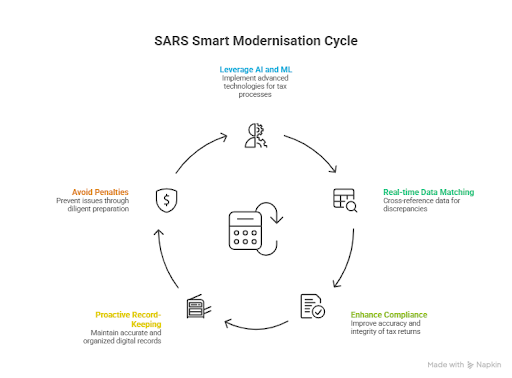
The South African Revenue Service (SARS) has embarked on an ambitious “Smart Modernisation” strategy, marking a pivotal shift towards leveraging advanced artificial intelligence (AI) and machine learning (ML). This initiative aims to revolutionise tax administration by embedding cutting-edge technology into every stage of the compliance process. At the heart of this effort is real-time data matching, which significantly enhances SARS’s ability to identify discrepancies or irregularities.
Before a tax return is even processed, SARS now cross-references information from bank statements, asset registries, and third-party financial data sources, creating a robust system of checks and balances.
This modernisation underscores the need for taxpayers and professionals to prioritise data accuracy and integrity. It’s no longer just about ensuring the mathematical correctness of a return, SARS’ automated systems can quickly detect inconsistencies, flagging taxpayers for further scrutiny and potentially imposing immediate penalties. With this heightened level of scrutiny, proactive record-keeping is essential to avoid unnecessary complications.
A Quick Checklist for “SARS-Ready” Digital Records
To prepare for this new era of tax administration, ensure your records meet the following standards:
- Updated Financial Documentation: Ensure all bank statements, income records, and financial transactions are current and reconciled.
- Clear Asset Registry: Maintain clear evidence of all owned assets, including purchase details and valuations.
- Third-Party Consistency: Cross-check that records match third-party data submitted by employers, financial institutions, or other entities.
- Accurate Expense Reporting: Verify that all deductible expenses are legitimate, documented, and compliant with SARS regulations.
- Organised Digital Storage: Store all relevant records digitally, securely, and in an easy-to-access format for submission when required.
The Implementation of the Global Minimum Tax and Its Impact on South Africa
The adoption of the OECD’s Pillar Two framework, introducing a 15% Global Minimum Tax, is a pivotal shift in the global tax landscape. For large multinationals operating in South Africa, it represents a strategic recalibration. Historically, corporations pursued tax optimisation through low-tax jurisdictions, but the focus has now transitioned to ensuring compliance with more transparent financial practices and maintaining operational substance.
This shift is actively reshaping cross-border investment strategies and elevating the complexity of international tax filings. Multinationals must now prioritise aligning their global structures in accordance with these new standards, requiring meticulous documentation and robust internal systems to meet the heightened demands of tax authorities.
Adding to this is South Africa’s recent removal from the FATF (Financial Action Task Force) Grey List, a significant milestone for the nation’s financial reputation. This improvement signals strengthened financial governance and renewed confidence in South Africa’s compliance with international standards. However, with this achievement comes the responsibility of ensuring the continued integrity of the financial system. South Africa must maintain elevated scrutiny on Anti-Money Laundering (AML) measures and enforce stringent “Know Your Client” (KYC) protocols.
Beneficial ownership vetting has become a sustained priority, demanding greater transparency from corporations and financial institutions alike. By incorporating ethical standards and adhering to these frameworks, businesses within South Africa can reinforce their global standing while mitigating risks in an increasingly interconnected economic environment.
Navigating the Two-Pot Tax Impact
The introduction of the ‘Two-Pot’ retirement system has marked a significant shift in how South African savers manage their retirement funds. After its first full year in operation, the system’s impact is becoming clearer, particularly in terms of its taxation implications. One of the most notable features of the system is the allowance for early withdrawals from the “savings pot,” which has introduced immediate tax liabilities for many individuals. These withdrawals are taxed as income in the year they are taken, potentially pushing some individuals into higher tax brackets and resulting in unforeseen financial burdens.
The ripple effect of this policy change has also extended to the national tax base. The increased volume of early withdrawals has provided a short-term boost to government revenue through higher tax collections. However, this trend raises concerns about the long-term sustainability of retirement savings, as funds intended for the future are being depleted prematurely. This underscores the critical role financial advisors must play in guiding clients. By providing clear, transparent advice on the tax implications of early withdrawals and the potential impact on retirement security, advisors can help individuals make informed decisions that balance immediate needs with long-term financial health.
The Necessity for Upskilling in a Data-Driven Era
The tax industry is undergoing a pivotal transformation, driven by advancements in technology and the increasing prevalence of data-driven systems. Today’s tax professionals can no longer depend solely on traditional accounting methods to meet the demands of this evolving landscape. Digital literacy, data analytics skills, and holistic problem-solving abilities have become essential to both survive and thrive in this new era.
A key driver of this change is the shift towards automated processes and e-filing systems, which demand a deeper understanding of digital tools and analytics. Tax practitioners must therefore engage in continuous professional development to remain compliant and competitive. Participating in education programmes that focus on emerging technologies, such as AI and blockchain, is no longer optional but imperative. Additionally, leveraging webinars, workshops, and certifications tailored to the digitalisation of tax frameworks can bolster a practitioner’s skill set.
Adapting to these changes also requires practical reforms within daily operations. Professionals should invest in advanced e-filing software and integrate analytics tools to streamline processes and derive actionable insights from client data. By adopting these proactive measures, tax professionals can not only enhance their value proposition in a data-driven market but also ensure they continue serving clients effectively in an increasingly fast-paced, technology-oriented world.
Prepare for the Future of South African Tax
The future of South African tax demands immediate attention to several critical factors. First, data readiness is no longer optional; efficient use of data is essential to navigating an environment increasingly shaped by advanced analytics and automated systems. Second, the reality of a shrinking tax base poses strategic challenges for taxpayers, requiring creative planning and adaptability.
Additionally, structural shifts driven by global integration and retirement reforms highlight the need for a forward-looking approach to maintain compliance and capitalise on potential opportunities.
Perhaps the greatest risk in 2026 is not a simple error in the numbers but failing to act swiftly in response to increasingly automated compliance systems. Taxpayers must stay ahead of the curve to avoid costly penalties and unnecessary complications.
To ensure you remain prepared, we encourage you to consult with a certified tax professional to review your financial strategies for 2026.